Waterkloof Ridge BlindsView-glass shading, made to measure
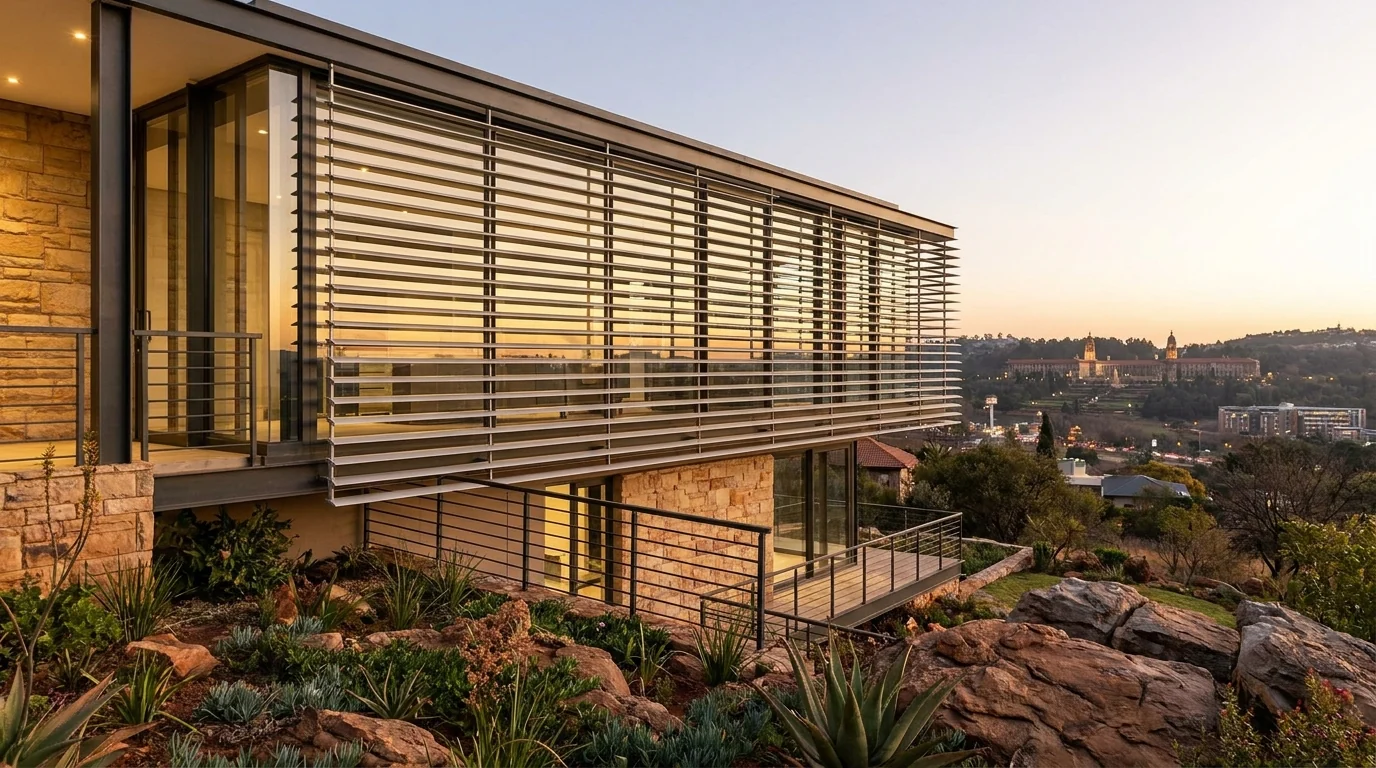
A contemporary Waterkloof Ridge home on a terraced koppie stand, external aluminium venetian blinds lowered across a wide glass wall to cut the low golden-hour sun, the Union Buildings visible across the valley

Home / The Field Guide

The Waterkloof Ridge View-Glass Field Guide

How the Pretoria sun crosses the ridge through the year, what it does to the big north- and west-facing glass a view home is built around, and what we'd fit on each elevation — with the honest catch on every option said out loud.

Written for Waterkloof Ridge, sources listed at the foot
Free to read, nothing to sign up for
Free measure & written per-window quote

Where to start

A house turned to face the view is a house turned to face the sun.

Waterkloof Ridge is built along a crest, and almost every plan up here is pointed the same way — outward, north and west, over the city bowl toward the Union Buildings and the koppies. That orientation is the reason people buy on the ridge. It is also the reason the glass needs a plan, because south of the equator the sun sits in the northern half of the sky all year, so the very walls framing the view are the walls taking the light.

Two things make the ridge its own specification, and both are easy to underestimate. The first is exposure: at roughly 1,300 m on the Highveld, under some of the clearest, highest-UV skies in the country, there is very little between a ridge window and the weather — a summer storm arrives from the west with almost no warning. The second is reach. Terraced koppie stands give you split levels, double-volume lounges and stairwell voids, so a good share of the glass in a ridge home is simply out of arm's reach. This guide walks the year, then the elevations, then the products — and ends with the two honest things a tape measure at the window still has to settle.

The light here

25.75° south, thirteen hundred metres up.

Every figure below is sourced at the foot of the page.

  1. Almost overhead in December, low and due north in June

    At the December solstice the midday sun stands about 88° over Pretoria — near vertical, so a roof, an eave or a terrace slab above the window does most of the shading at noon. By June that same midday sun sits at about 41°, due north, sliding in under the eave and reaching metres across the floor. Summer's high sun is the easy one; the low winter sun is the sneaky one, and it comes through the exact glass built to hold the view.

  2. In summer the sun rises and sets behind the ridge

    Around the December solstice first light comes from a bearing near 117° — well south of due east — and the sun drops out near 243°, south of due west, close to fourteen hours later. East and west glass takes hours of low, direct sun. In winter those points swing north to roughly 64° and 296°, so a west wall keeps catching the sunset almost the whole year round.

  3. West is the elevation that ruins the afternoon

    From early afternoon the sun swings toward that western setting point and keeps dropping — arriving low, horizontal and straight through the glass at eye level, at exactly the hour the lounge and the terrace are being used. No overhang catches sun that low, and no interior fabric answers it as completely as stopping the beam outside the pane does. This is the elevation worth spending on.

  4. Altitude buys you extra ultraviolet, all year

    UV intensity climbs roughly 10–12% for every 1,000 m of altitude, and at ~1,300 m under clear Highveld skies Pretoria records some of South Africa's highest readings — in the high-to-extreme band from about August right through to April. Ultraviolet is what fades a rug, a timber floor and, in time, the blind fabric itself, so here it is a year-round problem rather than a summer one.

  5. The rain comes as an afternoon storm, often with hail

    Pretoria is sunny — about 3,200 hours a year, with August the sunniest month — but the roughly 675 mm of rain is summer-concentrated and arrives as afternoon thunderstorms from about November to February. Highveld hail peaks in December and January and falls in the afternoon: exactly the hours an awning is most likely to be out. Anything living outside the glass on an exposed ridge stand gets specified around that storm arriving fast.

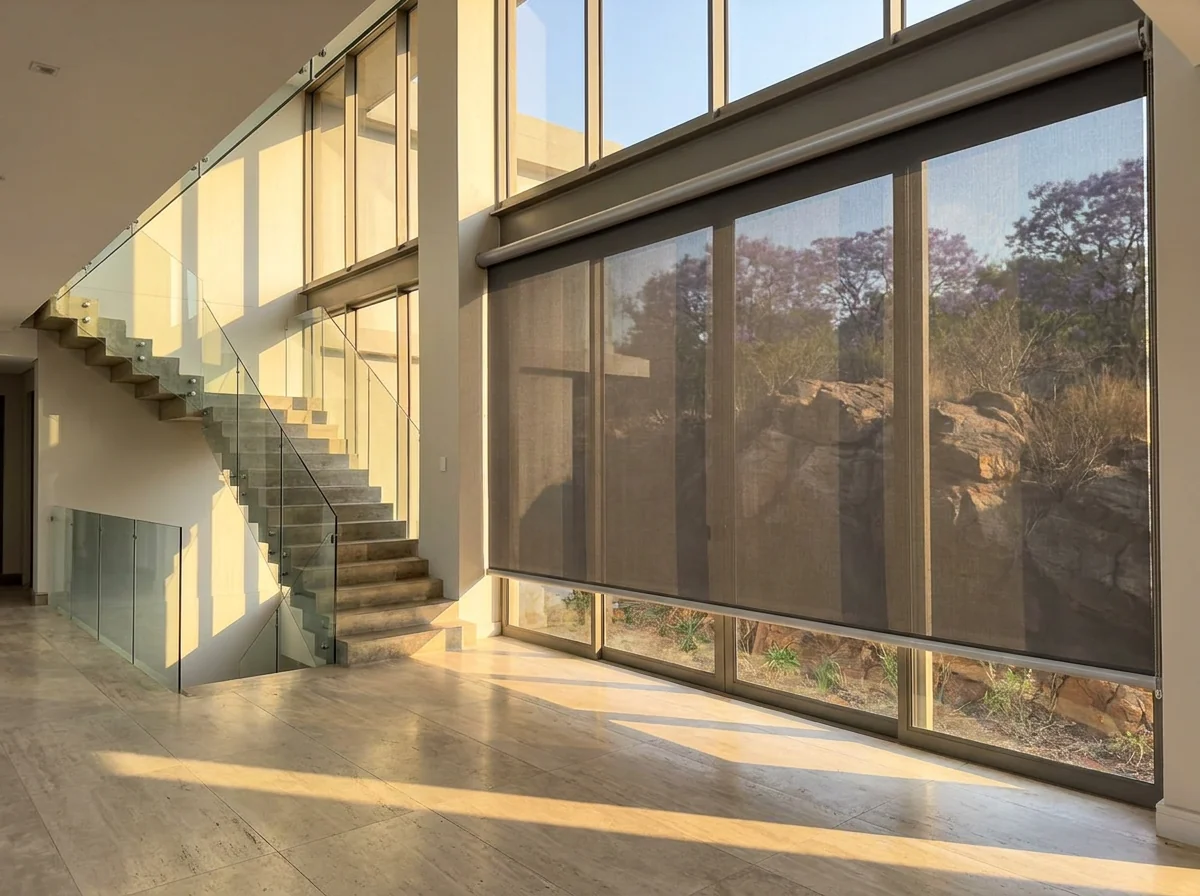
Motorised sunscreen roller blinds part-lowered across a tall double-volume stairwell void in a Waterkloof Ridge home, a rocky koppie outcrop and jacaranda canopy visible through the mesh weave
Glass you can't reach

The tallest glass in the house is the glass nobody can operate.

A stairwell void or a double-volume lounge is where the view is best and the reach is worst. Up here, a motor isn't a luxury — it's the only way the blind ever gets used.

Room by room

Four elevations, four different problems.

Walk the house once with the compass on your phone. Which way a window faces changes the answer more than what the room is used for.

  1. North — let the slab do the first job

    North glass takes a near-vertical summer sun and a low, welcome winter one, so it is the elevation where a horizontal projection earns its keep: a deep eave or a terrace slab above the window blocks most of December while still letting the low June sun in to warm the room for free. Where the slab already shades it, the interior blind is there for glare and UV, not heat — a sunscreen roller usually does it. Where there's no overhang, north glass behaves more like west.

  2. West — the elevation worth the budget

    Through the year the sun sets between about 243° and 296°, low and horizontal by then, arriving under any overhang and straight onto the glass. An interior blockout kills the glare instantly but the pane still heats and radiates into the room all evening; stopping the sun outside the glass keeps the room genuinely cooler. This is where external venetians, roller shutters or a zip screen pay for themselves — and where a view worth keeping argues for a tilting exterior slat over a solid drop.

  3. East — the same low sun, half the penalty

    East glass gets the mirror image from first light — near 05:15 in midsummer — but the air and the walls are still cool, so being woken early and morning glare matter more than heat gain. East bedrooms are a blockout conversation; an east breakfast room usually just wants a sunscreen mesh to take the hard edge off without losing the morning.

  4. South — late to it, and cheapest to solve

    Because midsummer sunrise and sunset both sit south of the east–west line, a south wall catches a low sliver early and late in December and almost nothing in winter. These are the flattest-lit, coolest rooms in the house — best left lightly dressed, with the budget moved to the west side where it earns far more.

What we'd fit, and why

The reasoning, and the honest catch with each.

Nothing here is right on every window. Each option below beats its obvious alternative on a particular ridge elevation, and each costs you something. Tap Add to my enquiry and it drops straight onto the form at the foot of the page — sizes optional.

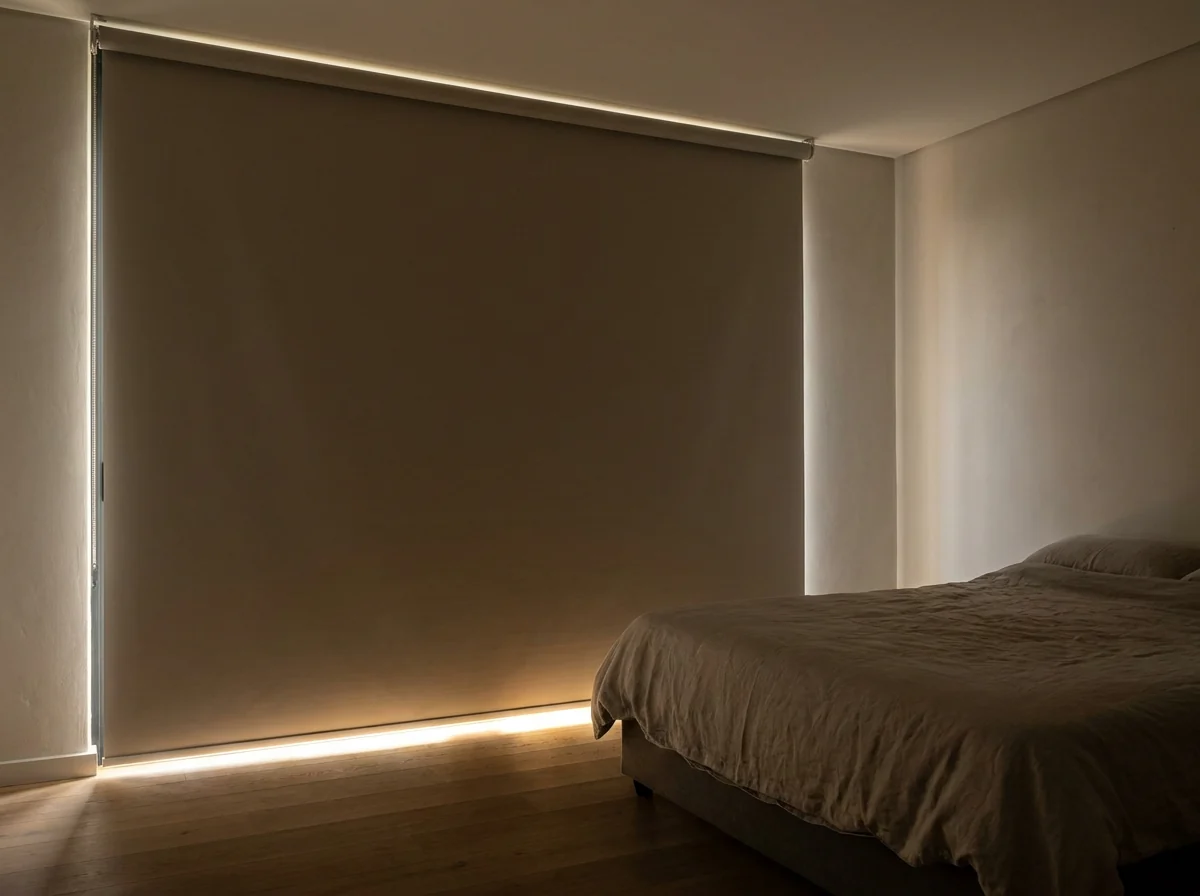
A blockout roller blind — one smooth flat sheet of fabric on a tube, no folds — fully lowered over a bedroom window at dusk, a thin line of light glowing around the edges

Roller blinds — sunscreen, blockout or day-night

Best on: view glass (sunscreen) · bedrooms (blockout) · rooms that change all day (day-night)

Why here. One smooth sheet of fabric on a slim tube — no folds, no fuss — is the workhorse for the sheer volume of glass a ridge home carries. A 3–5% openness sunscreen keeps the koppies visible from the couch while cutting glare and much of the fading UV; blockout does the opposite job for a bedroom or media room and adds a real thermal buffer on the morning-sun side. Day-night banding shifts one blind from open view to filtered light to privacy without ever being raised.

The catch. Sunscreen reverses after dark — lights on inside and the mesh you saw through all day now shows more in than out, so it's not a night-privacy fabric. Blockout is only as dark as its edges: inside a not-quite-square reveal a light line runs down each side. A double roller carries both fabrics on one bracket rather than making you choose, and a single blind runs to roughly 3 m before it's split or motorised and linked.
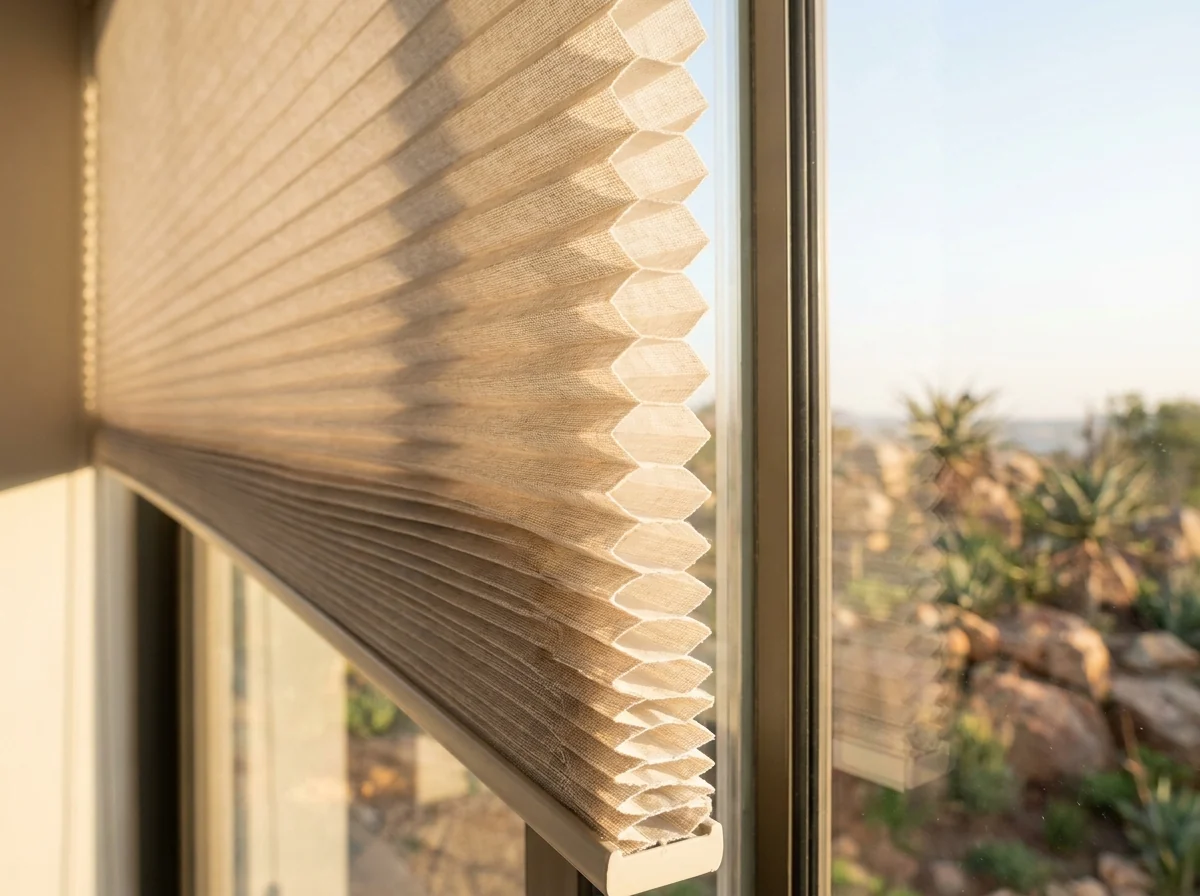
Close detail of a cellular honeycomb blind, the hexagonal air cells clearly visible in profile against a Waterkloof Ridge window with a rocky koppie garden beyond the glass

Cellular / honeycomb blinds

Best on: bedrooms and rooms that swing hot-to-cold · single-glazed older frames

Why here. The fabric folds into hexagonal cells that hold a layer of still air against the glass — the best-insulating interior blind made. On the ridge, a July dawn can sit near freezing while a January afternoon bakes, and that trapped-air layer is the least invasive way to steady a room: nothing about the window is altered. A top-down/bottom-up head lets you keep the sky and lose the passer-by.

The catch. It sits inside the glass, so against a hard west sun it's only slowing heat that has already come through the pane — an exterior product beats it there. On a bad west window the honest answer is often both: cellular for the winter comfort, something external for the summer heat.

Aluminium & timber venetians

Best on: studies and north rooms (timber) · kitchens and bathrooms (aluminium)

Why here. A low sun is a sideways problem, and a tilting slat answers it sideways — close the angle and the direct beam stops while the room stays bright and the view survives underneath. Timber suits a study or a north-facing room that wants warmth, not sheen; aluminium handles the wet rooms where fabric struggles, and throws daylight up onto the ceiling instead of into your eyes.

The catch. A venetian stacks deeper than a roller, so it eats a little more glass when fully raised, and timber dislikes steam — which is the whole reason wet rooms get aluminium instead.

External venetians & roller shutters

Best on: hard west and unshaded north glass with no useful overhang

Why here. Both stop the sun outside the glass, which is the only thing that keeps a west room genuinely cool rather than just dim. External venetians tilt, so you hold the view while killing the beam; roller shutters close fully into a slim head box for heat and blackout in one. On the ridge's worst afternoon glass, nothing interior comes close.

The catch. In relative terms these are the dearest answers in the guide, they want a motor and a wind strategy through storm season, and — fixed to the outside of the house — they're where the heritage note below bites. Shading, not security: our roller shutters are made for sun, heat, glare and privacy control on the outside of the glass. They are not security-rated shutters — a different product, which we can quote on request.

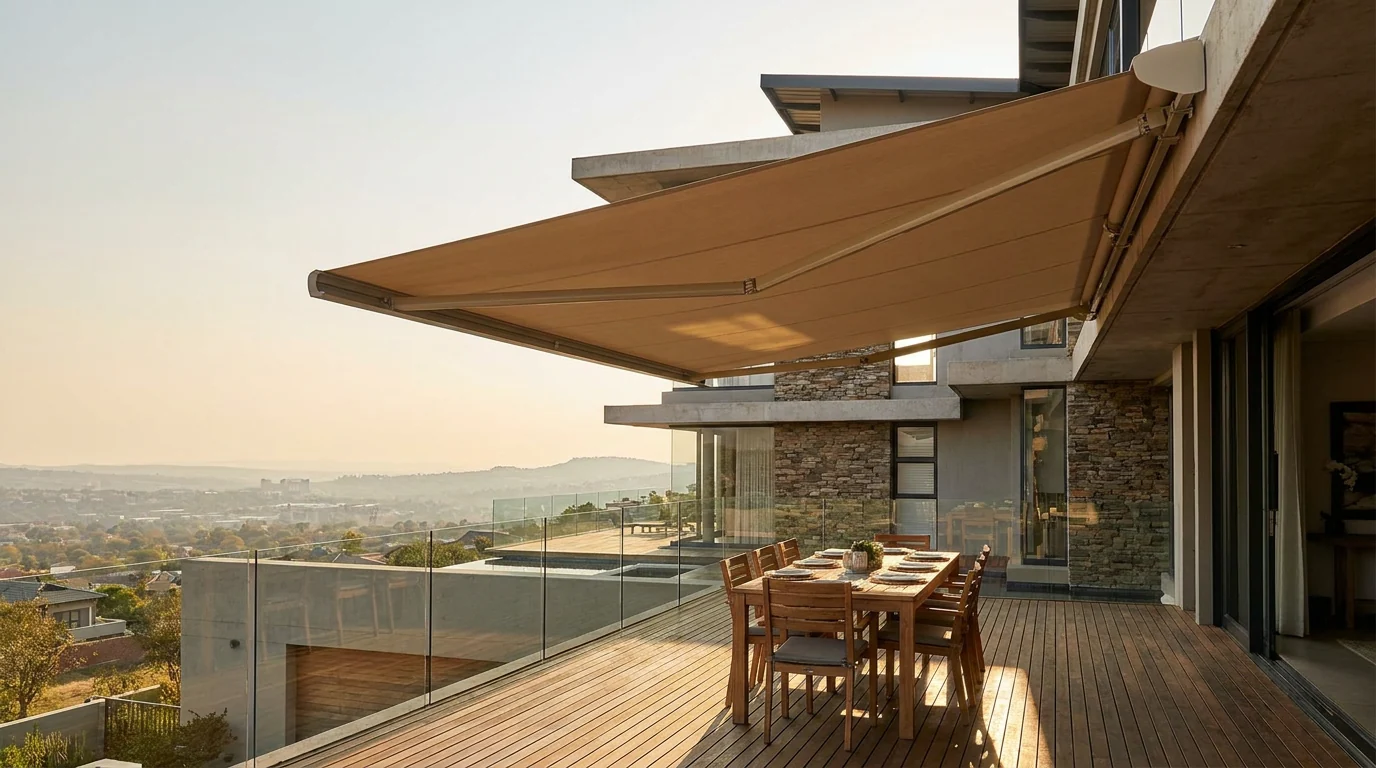
A folding-arm awning extended over a ridge-top entertaining deck with a set table beneath, the Pretoria valley falling away toward the city in late-afternoon light, no posts in the sightline

Folding-arm awnings & zip screens

Best on: the terrace, the entertaining deck and the open patio edge

Why here. A folding-arm awning shades the deck with no posts standing in the sightline out to the city bowl, then folds fully away so the view is never sitting under a roof — which is why it beats a fixed pergola on a terrace you actually use. A zip screen does a different job: tensioned mesh locked into side channels that holds its shape in a stiff Highveld breeze and keeps a west-facing patio usable in the low afternoon sun.

The catch. This is the Highveld from about November to March. An open awning arm caught in a sudden storm gust doesn't survive it, so on an exposed ridge stand we'd specify a motor and a wind sensor rather than a manual awning — a fixed zip screen in channels handles gusts an open arm can't.

Motorisation & automation

Best on: stairwell voids, double-volume walls and anything living outdoors

Why here. Half the glass in a terraced ridge home is above a stairwell or two storeys up a double-volume wall, and a blind nobody can reach is a blind nobody adjusts. A sun sensor drops the west blinds at three in the afternoon on its own; outdoors, a wind sensor retracts an awning before a storm arrives — including while the house is empty.

The catch. Motors need power, and finding a cable route on a split-level or terraced stand is a real question — sometimes there's a ceiling void to run it through, sometimes the honest answer is a battery motor and a charge every few months.

Optional

Want this guide marked up for your own house?

Tell us which rooms or elevations are the problem and we'll send this back to you with notes against your actual glass — which of the answers above we'd start with, and which we'd leave alone. No visit involved, and no obligation to book one.

We use these details only to send you the guide and, if you ask for it, to arrange a consultation call-back (POPIA). No marketing lists, no sharing with third parties.

Estate, heritage & the reserve edge

Inside the reveal is your call. Outside it, ask first.

The ridge and the embassy belt below it carry a lot of older stock, and age alone matters. Section 34(1) of the National Heritage Resources Act says no one may alter or demolish a structure — or part of a structure — older than sixty years without a permit from the provincial heritage authority, which in Tshwane is PHRA-G. The trigger is the sixty years, not whether the house is on a register.

That draws a clean line through this guide. A blind fitted inside the reveal — rollers, venetians, cellular, day-night — is a furnishing decision and touches neither the structure nor how the house reads from the street. Anything fixed to the outside of the glass — external-venetian guide rails, a roller-shutter head box, an awning cassette, zip-screen channels — is a change to part of the facade, and on a home older than sixty years may need a PHRA-G permit first. Many embassy and diplomatic residences on the belt also run their own exterior-approval process, so on those addresses we'd ask before anything is ordered. We fit blinds; we're not heritage practitioners, so we raise it at the measure and design a strong interior option either way.

One more ridge-and-reserve note: stands backing onto the Groenkloof Nature Reserve get visiting wildlife, vervet monkeys included, so on reserve-edge ground floors we'd steer you toward cordless or motorised operation — nothing dangling for a curious monkey, or a small child, to reach.

Before anything gets ordered

Five things only a tape measure at the window can settle.

The honest limit of any guide, ours included. Everything above narrows the field; these five decide it — which is the whole reason the free measure exists.

  1. True reveal depth, and whether the opening is square

    Depth decides whether an inside mount is even possible, and how much light escapes past a blockout down each edge. On a terraced house cut into rock, reveals vary wall to wall — measured in three places, never one.

  2. What the frame is, and what it can carry

    Aluminium, steel casement and timber each take a fixing differently, and stone cladding or a face-brick facade changes where an exterior rail can actually anchor. We need to see the frame in the flesh before promising a mount.

  3. How exposed that elevation really is

    Anything external lives or dies on wind exposure through storm season. A terrace tucked behind a gable and one open to the west are different specifications — sometimes different products entirely — and no floor plan tells us which yours is.

  4. Where the power for a motor can run

    Motorising a stairwell void or a double-volume wall is simple in principle and fiddly on a split-level stand: the cable has to arrive without chasing a finished wall. Sometimes there's a ceiling void; sometimes the answer is a battery motor.

  5. What the eave, the terrace slab and the koppie already shade

    A fair share of a ridge home's afternoon shade is already thrown by a deep eave, a terrace above, or the slope itself. Knowing which windows need no spending at all is worth as much as knowing which ones do.

Two ways forward

Have us come and measure — or just get a range first.

Both start on the one short form below. We take five or six measure appointments a week across the ridge and the belt, so the diary tends to fill early.

Recommended

The free expert measure & written quote

A consultant comes with fabric and slat samples, measures every opening properly, reads each elevation with you at the hour that actually matters, and leaves an itemised written quote per window. Free, and no obligation to go ahead.

Book my free measure

Optional

Want a ballpark first?

Pop in rough sizes and we'll send a budget range by the next working day. Not sure how to measure? Leave it — the consultant measures for free and you'll get exact per-window pricing either way.

Open the window list

The close

Book your free expert measure.

One short form. Add rough window sizes underneath it if you'd like a budget range as well — that part is entirely optional, and never a substitute for the free measure.

What you're interested in (tick anything from the guide)
Optional: add rough window sizes for a budget range+

Rough is genuinely fine — a tape across the outside of the frame is enough. We'll send a budget range by the next working day. If measuring isn't your thing, skip this entirely: the free measure gives you exact per-window pricing anyway.

Your window list — room, width, drop, mount and product for each window
RoomWidth (mm)Drop (mm)Inside or outside the revealProductRemove

Nothing on the list yet — it is entirely optional.

We use these details only to arrange your consultation call-back and, if you've added sizes, to send your budget range (POPIA). No marketing lists, no sharing with third parties.

Sources

Where the numbers on this page come from.

Every climate, sun-path, heritage and geography figure above is taken from the following. Where a figure was disputed or unverifiable we left it out rather than round it into a sentence.

Reading this from another suburb? The same sun-path reasoning applies across Waterkloof, Waterkloof Heights, Brooklyn and Groenkloof — the housing stock and the exposure are what change.