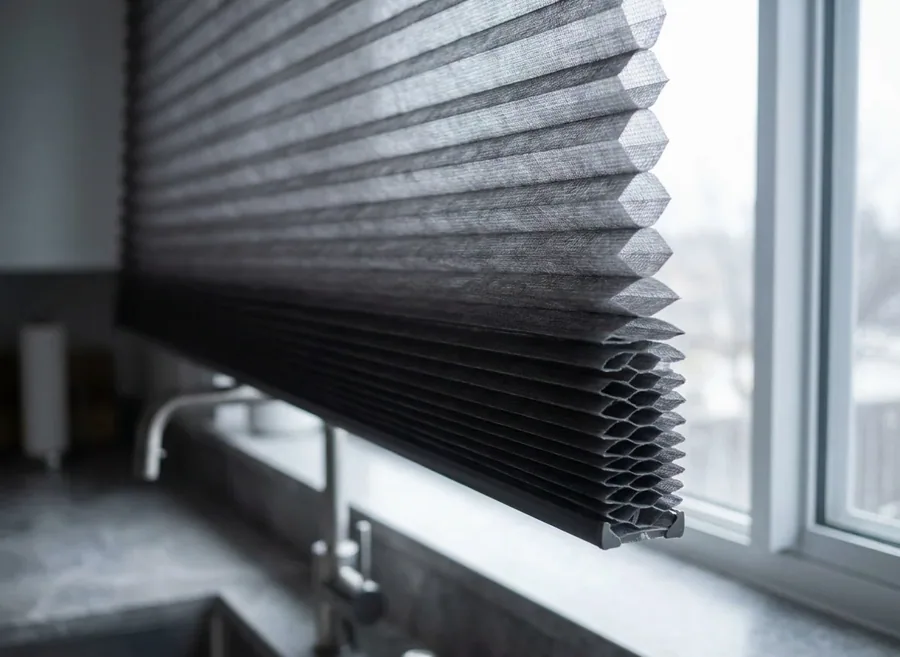
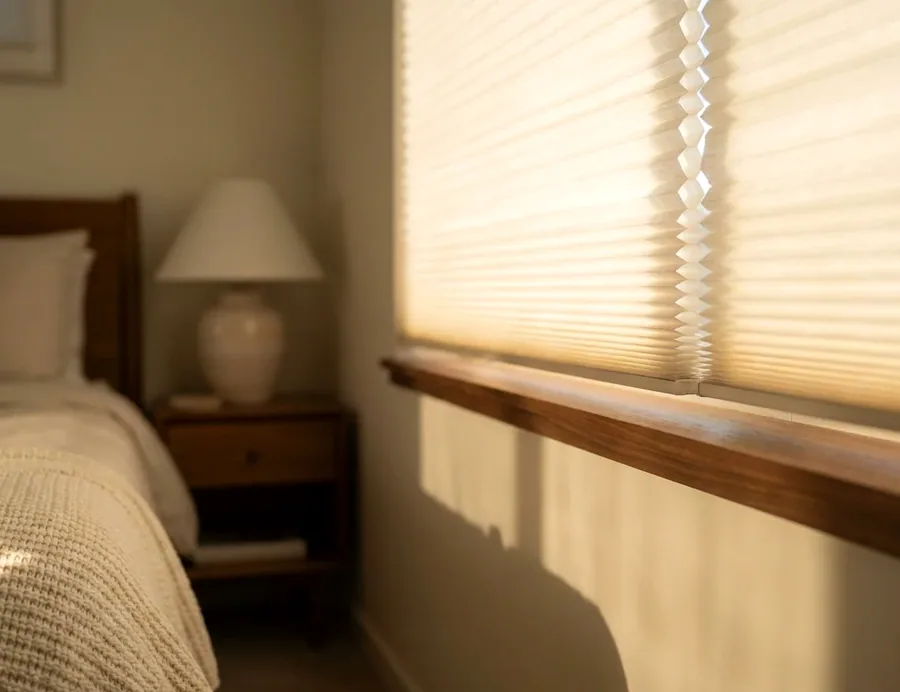
A design home built for the view usually means less wall and more glass than a typical house — beautiful, and thermally demanding. Cellular blinds work on a simple principle: trapped air is insulation. The honeycomb profile forms a soft buffer against the glass in both directions, taking the edge off a hot afternoon and a cold highveld night from the same product.
Double-cell fabrics do the most serious thermal work, and they're worth specifying on rooms with real heating or cooling bills — a lounge under a double-volume glass wall, or a room over an open garage that's always either too hot or too cold. Single cells suit milder rooms where the priority is comfort and quiet rather than a full thermal upgrade.
Trapped air is insulation. It's also the smallest stack of any blind when raised.
Top-down/bottom-up operation is a genuine feature on the ridge, not a gimmick — privacy at the bottom of a street-facing window while the sky and the view stay visible up top. Blockout cell fabrics add real bedroom darkness with the thermal bonus built in, and shaped versions exist for skylights and raked gable glass, since the cell structure holds its form on an angle.
Practical notes
- Cordless and motorised operation available; the slimmest stack of any blind when fully raised.
- Top-down/bottom-up for overlooked and street-facing windows — privacy below, light and view above.
- Blockout cell fabrics for bedrooms and nurseries; light-filtering for living areas.
- Skylight and shaped-window versions available where the roof carries glass too.